Why does Bill Gates call AI more dangerous than nuclear weapons?
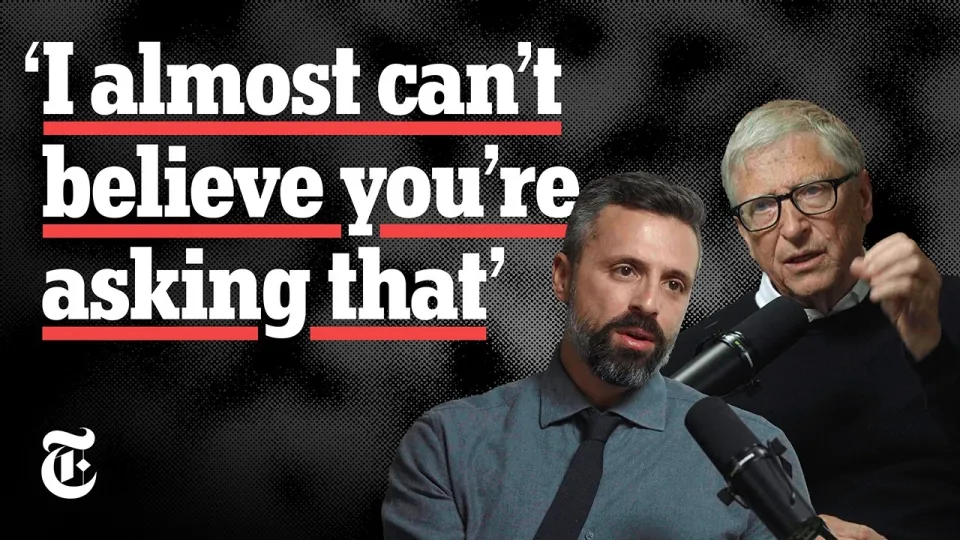
Video: Bill Gates: A.I. ‘Makes Nuclear Weapons Look Like Nothing’ | The Ezra Klein Show
Want articles like this for your own video to promote it on YouTube and Google? Order them through the Telegram bot @sat_sit_bot. Articles with your video embedded are written and posted by the bot itself — on popular topical sites (no ads). Your first 50 articles are free.
Key takeaways
- Gates says AI is the most dangerous technology humanity has approached, framing it as a bigger threat than nuclear weapons.
- He names two hard thresholds: AI-enabled cyberattacks and bioterrorism capable of killing at a scale no lawsuit can address.
- Industry self-regulation is "insane" in Gates's view; government-set thresholds and licensing are the alternative he argues for.
- Gates calls the AI race with China real but insists safety rules must be coordinated rather than dropped for speed.
- The Gates Foundation is set to spend down roughly $200 billion over two decades, with AI-driven inequality as a new priority.
Bill Gates argues that artificial intelligence is the most dangerous technology humanity has ever approached, more consequential than nuclear weapons, because it lowers the cost of catastrophic misuse and arrives faster than institutions can respond. In his conversation with Ezra Klein, he says the answer is not alarmism but binding government rules, since letting the AI industry regulate itself is, in his word, "insane." The full transcript of the discussion is available at the New York Times opinion page for the episode.
Gates does not arrive at this position as a newcomer to the subject. As Microsoft's co-founder and the chair of the Gates Foundation, he spent years as the tech optimist who treated AI as a tool for health, education and development. The shift in the interview is not about capability but about speed: systems that once seemed decades away crossed thresholds he did not expect to see so soon, and the policy world has not caught up.
What changed in Bill Gates's view of AI
Gates describes a personal update rather than a reversal. He long believed AI would be transformative but distant, and he now treats it as something already superhuman on narrow tasks and improving faster than any prior technology he has watched. That matters because his optimism was always conditional on institutions keeping pace. When they do not, the same capability that could diagnose disease or tutor a student becomes a weapon anyone can rent.
His framing is deliberately blunt: AI "makes nuclear weapons look like nothing." Nuclear arms are expensive, require fissile material and leave fingerprints. Software does not. A model that can be copied, fine-tuned and deployed by a small group compresses the distance between intent and mass harm, and Gates says the people in positions of authority are in denial about how short that distance has become.
The cyber and bio thresholds Gates says we are crossing
Two specific risks carry most of his concern, and both are thresholds rather than vague fears. The first is cyber: AI that can find and exploit vulnerabilities at machine speed against power grids, hospitals, financial systems and water utilities. The second is bio: models that make it easier to design and produce dangerous pathogens. Gates's test is simple and uncomfortable. If an event could kill tens of millions of people, the response cannot be litigation after the fact.
That is why he dismisses the idea that courts and reputational damage will discipline AI labs. In the interview he reacts with near-disbelief to the suggestion that a lawsuit is an adequate remedy for a catastrophe-scale failure, saying he can barely keep a straight face. Liability arrives after the funeral. Regulation has to arrive before the release.
Why self-regulation fails in AI
Gates's argument against industry self-regulation rests on incentives, not character. Companies compete on capability, and any lab that slows down unilaterally hands advantage to rivals, which means voluntary restraint is unstable by design. He compares the industry to sectors that once promised to police themselves and eventually required statutes, agencies and licenses.
- Set explicit thresholds: capability levels that trigger mandatory testing, disclosure and deployment pauses.
- License frontier training runs, the way nuclear and aviation activity is licensed, rather than trusting post-hoc audits.
- Require independent evaluation before release, with results shared with regulators, not just boards.
- Build international coordination so safety rules do not become a unilateral handicap.
Gates is careful about the China question. He treats the AI race between the United States and China as genuine and consequential, but rejects the inference that competition justifies dropping safeguards. A race in which both sides cut corners produces the same catastrophe for both, and he argues the two governments have more shared interest in preventing a bio or cyber disaster than in winning a sprint.
Jobs, inequality and the case for taxing AI labor
Beyond security, Gates expects labor-market disruption at a scale he compares to nothing in his lifetime. White-collar tasks that seemed safe, from drafting to analysis to customer support, are exactly what current systems do well, and the transition may be faster than workers can retrain. He does not predict a world without work, but he does predict a difficult gap between displacement and new demand.
The policy toolkit he sketches is unglamorous. Tax AI labor in some form so that automation does not enjoy a structural advantage over human employment. Fund retraining that is tied to actual openings rather than generic courses. Protect roles he calls "human reserved," where people explicitly want a person on the other end, such as care, teaching and certain public services. And treat AI-driven inequality as a first-order problem: the Gates Foundation has made making AI a force for equality, rather than an accelerant of inequality, a new priority, alongside a planned spend-down of roughly $200 billion over two decades.
What viewers pushed back on
The reaction to the episode clusters around a few honest disagreements. One is temperament: viewers noted that Gates seemed unusually agitated, and read that as evidence rather than theater. If the technologist who spent decades selling optimism is alarmed, the alarm is harder to dismiss as hype.
A second thread targets the free-market defense of AI, often attributed to Nvidia's Jensen Huang, that competitive capitalism naturally punishes harmful products. The counterargument in the comments is that this logic assumes consumers can see the harm and switch before it lands, which fails when the harm is a pandemic or a grid failure. A third theme is Gates's willingness to disagree with his host without interrupting him, which several listeners read as a model for how to argue about risk without performing it.
The education and children's-safety angle
Gates extends the regulatory argument to children. He points to learning loss in rich countries as evidence that schools need better tools, not fewer, and that AI tutoring could narrow gaps if access is universal. At the same time he supports age-appropriate rules for AI products aimed at minors, covering data use, persuasive design and content. The same technology that can tutor a student can also manipulate one, and he treats that as a design and policy question rather than a matter of parental vigilance alone.
Useful links
- Full transcript of the Bill Gates conversation on The Ezra Klein Show
- Book recommendations from guests of The Ezra Klein Show
The bottom line
Gates's message is not that AI should be stopped but that it is being deployed without the institutions that made nuclear power survivable. He wants thresholds, licenses, independent testing and international coordination, and he thinks the window for building them is short. The discomfort in the interview comes from a specific claim: the people with authority to act do not believe the risk is real. This analysis draws on the conversation published by The Ezra Klein Show, which remains the best place to hear the argument in Gates's own words, including the moments where he pushes back hardest on his host.
Source: Bill Gates: A.I. ‘Makes Nuclear Weapons Look Like Nothing’ | The Ezra Klein Show · Markdown version
Questions & answers
Why does Bill Gates compare AI to nuclear weapons?
Gates argues that AI is cheaper to acquire, easier to copy and harder to trace than nuclear material, so a small group can cause harm at a scale that previously required a state. He also says the technology is advancing faster than the institutions meant to govern it, which is why he calls it the most dangerous thing humanity has approached.
What does Gates propose instead of industry self-regulation?
He wants government-set capability thresholds that trigger mandatory testing and deployment pauses, licensing for frontier training runs, independent evaluation before release, and international coordination so no single country bears the cost of moving first. He rejects the idea that lawsuits after a disaster can substitute for rules before release.
Does Gates think the AI race with China should slow safety work?
No. He treats the US-China competition as real but argues both governments share a stronger interest in preventing a bio or cyber catastrophe than in winning a speed contest. Dropping safeguards to move faster produces risks that do not stay inside one country.
What does Gates say about AI and jobs?
He expects rapid displacement of white-collar work and a difficult gap before new roles appear. His proposals include taxing AI labor in some form, funding retraining tied to real openings, and protecting "human reserved" roles in care, teaching and public services where people want a person.